What the NAD test measures
One clear figure: the total NAD in your capillary blood, placed in one of five bands for people of your age and sex.
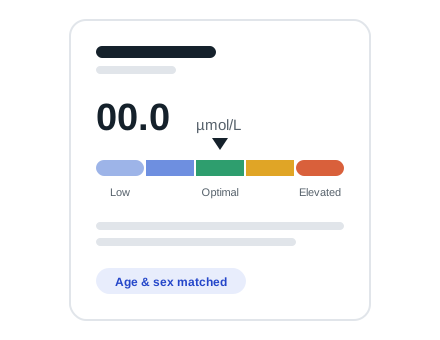
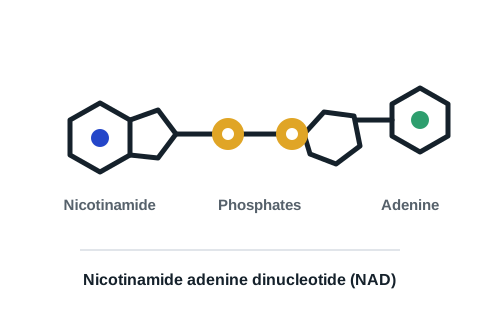
Total NAD, in µmol/L
The lab measures total NAD in your dried blood spot using an enzymatic cycling assay, and reports it in micromoles per litre (µmol/L).
NAD exists in two forms, NAD+ and NADH. This test measures them together as one total. It doesn't report them separately or give a ratio between them.
Compared with people like you
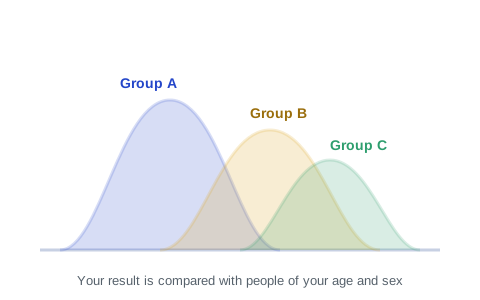
The reference range comes from a study of 1,068 people. It was narrowed to those who met health-based criteria, then split by age and sex.
So your result isn't compared with everyone. It's compared with people of your own age and sex.
- Low
- Low–normal
- Optimal
- High–normal
- Elevated
Your five result bands
Your report places your result in one of five bands.
Low
Below the range for people of your age and sex.
Low–normal
At the lower end of the range.
Optimal
Within the central part of the range.
High–normal
At the upper end of the range.
Elevated
Above the range. This often reflects heavy supplementation.
Test quality
The collection kit is CE-marked under the EU IVDR (2017/746) and manufactured to ISO 13485. That covers the quality and safety of the kit. It doesn't make this a diagnostic test. Your sample is analysed by a licensed clinical laboratory in the EU that takes part in international NAD quality assessment schemes. It's identified by barcode only, so no personal details are passed to the lab.
5–60
µmol/L measuring range
The range over which results are linear and reliable.
0.23
µmol/L detection limit
The smallest amount of NAD the assay can detect.
6.6%
Precision (RSD)
How closely repeat measurements of the same sample agree.
Higher isn't automatically better
There is no established clinical target for blood NAD, and no evidence yet that changing your level changes health outcomes. An elevated result often reflects heavy supplementation rather than better health.
The test is most useful for seeing where you start and whether a precursor is changing your level.
It doesn't measure biological age. NAD is one molecule. It can't tell you how fast you're ageing or predict lifespan.
Know your number
One finger-prick at home, and a result placed against people of your own age and sex.
- Total NAD in capillary blood, in µmol/L
- Five-band result, matched to your age and sex
- CE-marked kit, analysed by a licensed clinical laboratory
- Results within 2 weeks, with prepaid return postage